The problem
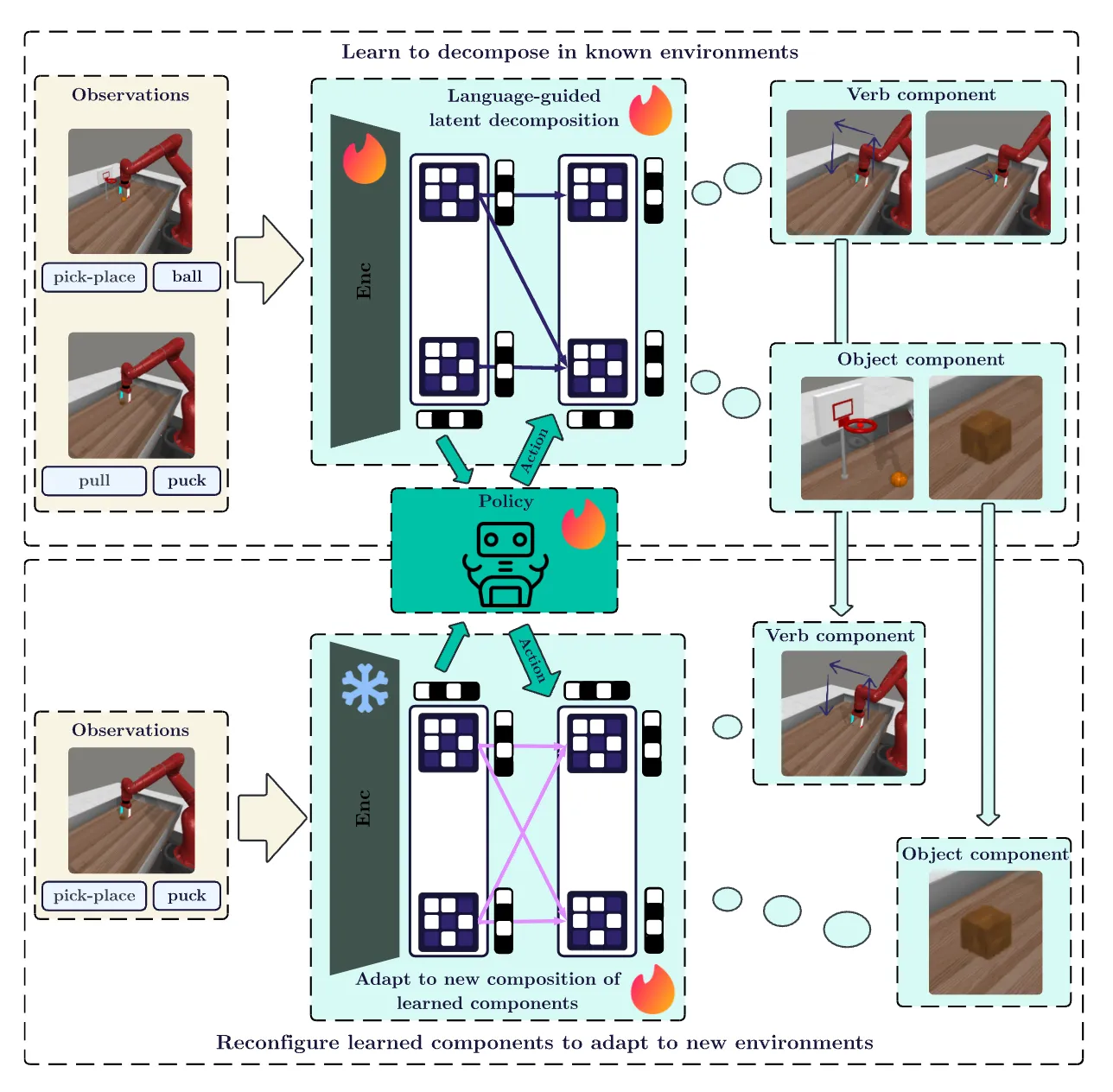
Generalization in reinforcement learning remains a significant challenge, especially when agents encounter novel environments with unseen dynamics. Drawing inspiration from human compositional reasoning — where known components are reconfigured to handle new situations — we introduce World Modeling with Compositional Causal Components (WM3C), a framework that enhances RL generalization by learning and leveraging compositional causal components.
The method
WM3C integrates language as a compositional modality to decompose the latent space into meaningful components, and provides theoretical guarantees for their unique identification under mild assumptions. Our practical implementation uses a masked autoencoder with mutual information constraints and adaptive sparsity regularization to capture high-level semantic information and effectively disentangle transition dynamics.
Key highlights
Identifiability. Theoretical guarantees provide a solid foundation for compositional causal learning.
State of the art. WM3C achieves state-of-the-art performance in generalizing to unseen environments.
Simulated and real. Significant improvements in both simulated and robot manipulation tasks.